

Coco Chanel

Coco Chanel
secular sainthood, image-worship, and the liturgy of desire
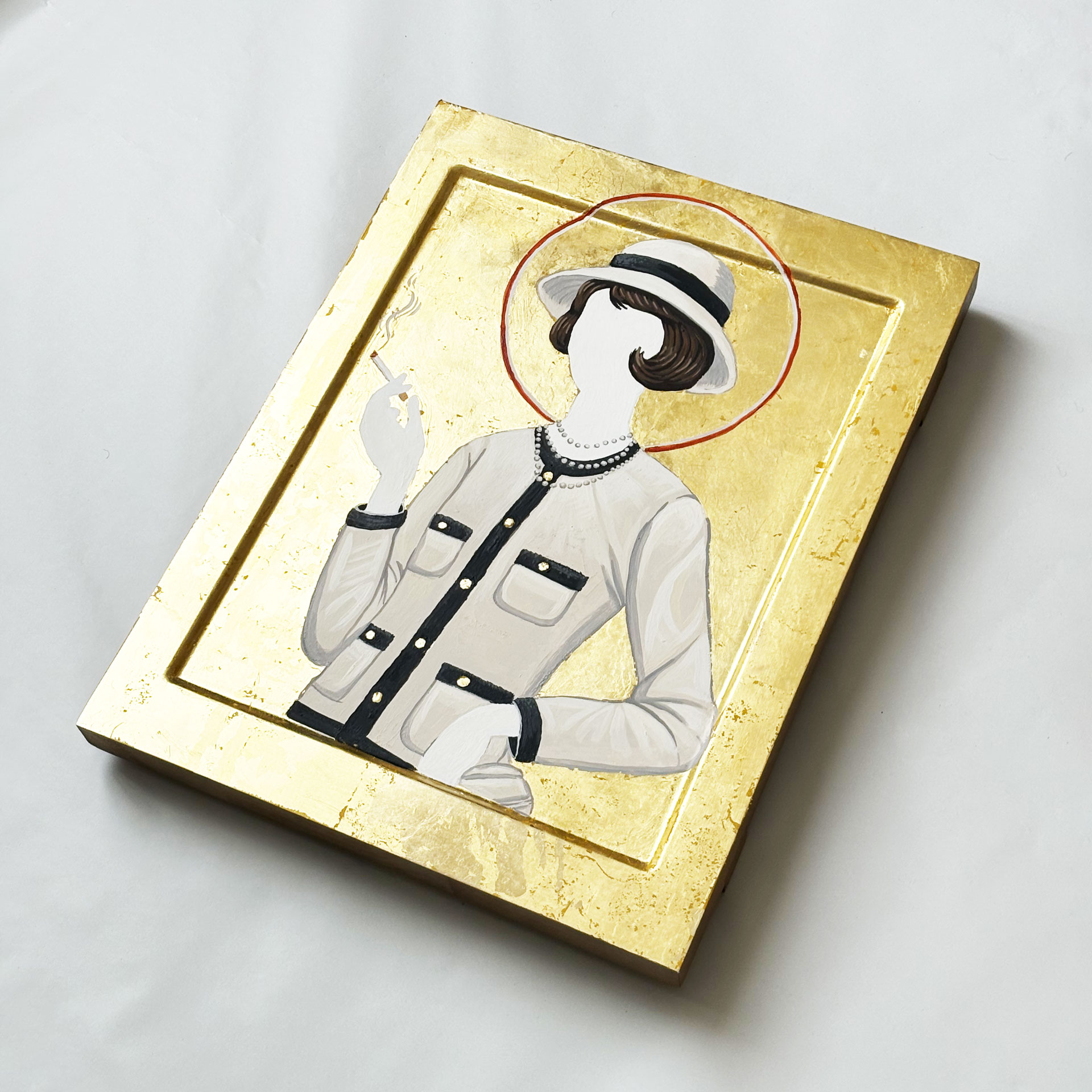
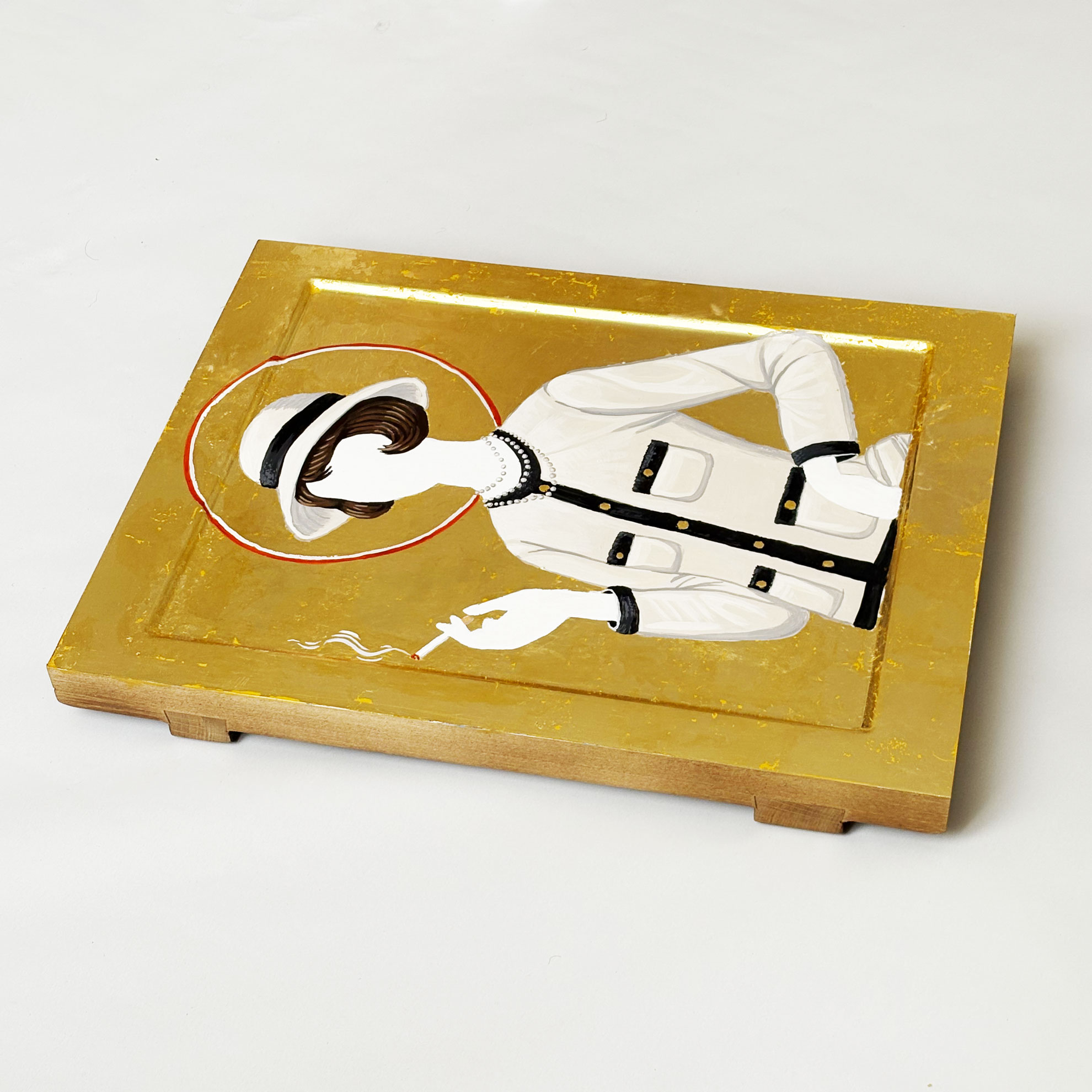
In this panel, Coco Chanel does not appear merely as a historical figure, nor simply as a fashion icon: she appears as an object of devotion. That is where the work draws its true force. Filippo Riniolo does not “portray” Chanel so much as he canonises her—critically.
The choice of egg tempera and 24-carat gold leaf is neither technical affectation nor decorative quotation. It is a deliberate act of positioning. Riniolo adopts the material language of the Byzantine icon in order to transpose it onto the symbolic body of Western modernity, revealing that the sacred has not disappeared but merely changed its address. We no longer venerate saints and martyrs alone; we venerate brands, gestures, lifestyles, and media-born myths.
The image is composed with near-liturgical discipline: the gold ground, the red halo, the poised frontality, the suspension of time. Yet at its centre, where one expects a face, there is an absence. This effacement is crucial. Chanel becomes archetype rather than individual. Not psychology, but function. Not personhood, but symbolic apparatus. She is rendered as the distilled form of the contemporary “icon”: universally recognisable, yet ultimately inaccessible—circulating everywhere, possessed by no one.
What is especially striking is the work’s intelligence of tone. Riniolo avoids caricature altogether. He neither trivialises luxury nor sermonises against elegance; he refuses the blunt instrument of satire. Instead, he undertakes something subtler, and far more exacting: he lays bare the machinery of veneration. The white jacket edged in black, the pearls, the hat, the cigarette—each element operates as sign, code, relic within a secular religion founded upon distinction, desire, prestige, and imitation.
And then there is the crucial detail: the cigarette. Within the visual economy of the painting, its smoke inevitably evokes incense. Here the title of the series (Of Heroin and Incense) finds one of its sharpest formulations: the boundary between rite and addiction, between ecstasy and consumption, between elevation and dependency, becomes troublingly porous. A worldly gesture is transfigured into a sacred one. The icon does not pronounce judgement; it stages an exposure. Precisely for that reason, it compels the viewer to take a position.
Philosophically, the work operates as an archaeology of the present. Riniolo probes the longue durée of the Western image, placing the Christian iconographic tradition in tension with our contemporary culture of visibility, display, and symbolic capital. The central question is not merely what we represent, but what we choose to worship through representation. It is a political question before it is an aesthetic one.
In this sense, Riniolo’s Coco Chanel is more radical than it may first appear. It does not celebrate a twentieth-century myth; it stages that myth’s afterlife within today’s economy of images and desire. The gold ground does not simply glorify Chanel: it illuminates our own gaze, and in doing so places it under scrutiny. It reminds us that every age builds its altars—and that the real danger lies not in having them, but in no longer noticing when we kneel.
Date
25 February 2026
Category
icons